Queen's South Africa Medal
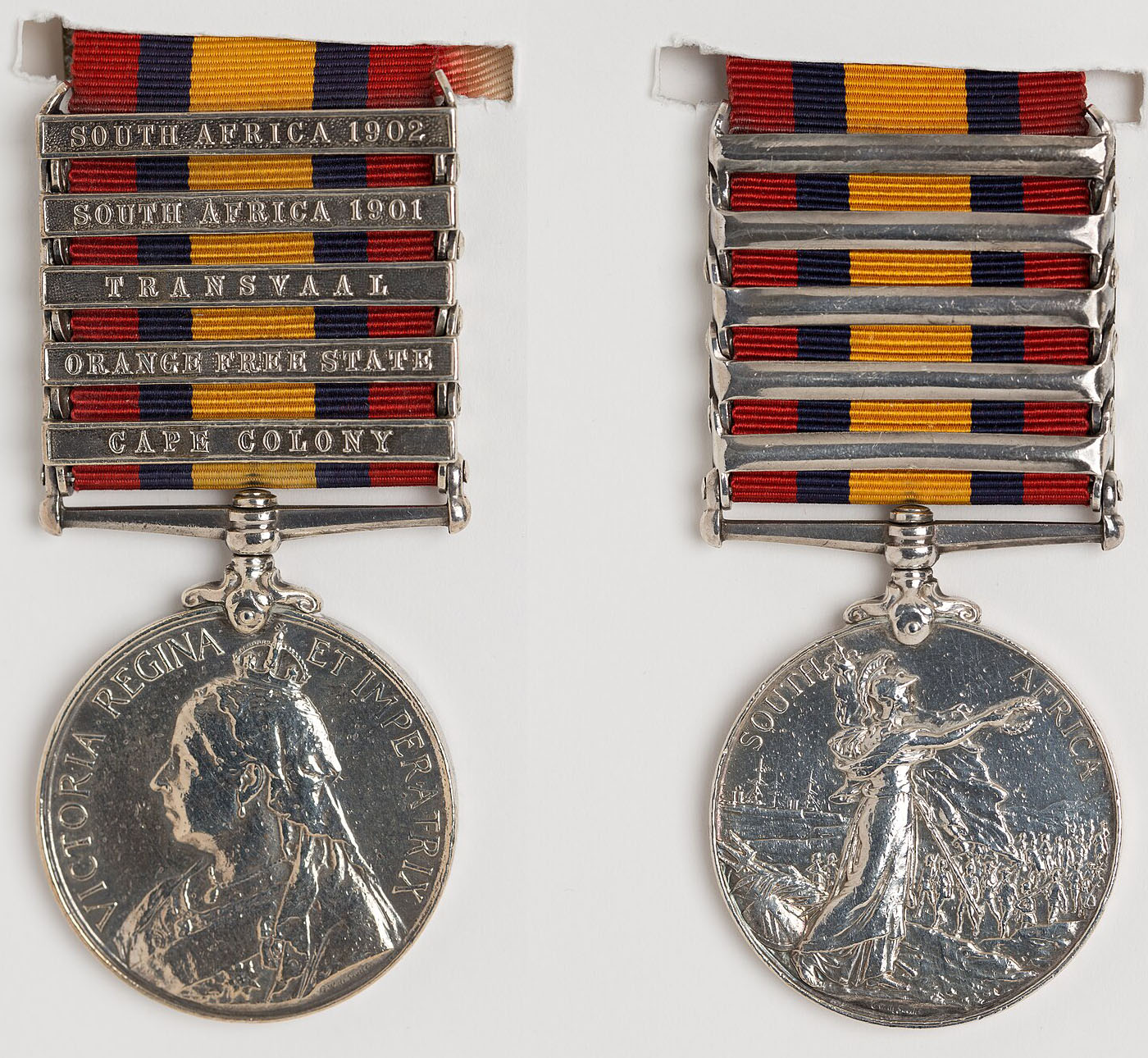
The Queen's South Africa Medal was instituted by Queen Victoria in 1900, for award to military personnel and civilian officials who served in South Africa during the Second Boer War from 11 October 1899 to 31 May 1902.
A total of 27 different Clasps were awarded to indicate participation in campaigns
- Cape Colony (11 October 1899 to 31 May 1902). For service in the Cape of Good Hope where no clasp for a specific action in the Cape had been received,
- Natal (11 October 1899 to 11 June 1900). For service in Natal where no clasp for a specific action in Natal or the Cape of Good Hope, nor the "Cape Colony" clasp, had been received.
- Rhodesia (11 October 1899 to 25 May 1900). For service under the command of Lieutenant General Sir F. Carrington and Colonel Herbert Plumer in Rhodesia between 11 October 1899 and 17 May 1900, or who landed at Beira, Mozambique, between 11 October 1899 and 25 May 1900.
- Relief Of Mafeking (11 October 1899 to 17 May 1900). Awarded to troops under the command of Colonel Plumer, who were south of an east–west line drawn through Palachwe in Bechuanaland Protectorate between 11 October 1899 and 17 May 1900, and to those under the command of Colonel Bryan Mahon who marched from Barkly West, Cape of Good Hope on 4 May 1900.
- Defense Of Kimberley (14 October 1899 to 15 February 1900). Awarded to the garrison of Kimberley, Cape of Good Hope, during the siege.
- Talana (20 October 1899). Awarded to those under Major General Sir William Penn Symons' command who were north of an east–west line drawn through the railway station at Waschbank, Natal.
- Elendslaagte (21 October 1899). Awarded to those at Elandslaagte, Natal, who were on the right bank of the Sunday River in Natal and north of an east–west line drawn through Buys Farm.
- Defence Of Ladysmith (3 November 1899 to 28 February 1900). Awarded to the garrison of Ladysmith, Natal, during the siege.
- Belmont (23 November 1899). Awarded to troops under Lieutenant General Lord Methuen's command who were north of Witteputs, Cape of Good Hope.
- Modder River (28 November 1899). Awarded to those under Lieutenant General Lord Methuen's command who were north of Heuningneskloof, Cape of Good Hope (exclusive), and south of the Magersfontein ridge.
- Tugela Heights (14 to 27 February 1900). Awarded to those of the Natal Field Force, exclusive of the Ladysmith Garrison, employed in the operations north of an east–west line drawn through Chieveley Station.
- Relief Of Kimberley (15 February 1900). Awarded to those in the relief column under Lieutenant General French who marched from Klipdrift, and 6th Division troops under Lieutenant General Thomas Kelly-Kenny who were within 7,000 yards of Klipdrift.
- Paardeberg (17 to 26 February 1900). Awarded to troops within 7,000 yards of General Piet Cronjé's final laager in the Orange Free State, and within 7,000 yards of Kudusrand Drift.
- Orange Free State (28 February 1900 to 31 May 1902). For service in the Orange Free State where no clasp for a specific action in the Orange Free State had been received.
- Relief Of Ladysmith (15 December 1899 to 28 February 1900). Awarded to those in Natal north of and including Estcourt.
- Dreifontein (10 March 1900). Awarded to those with Army Headquarters, and Lieutenant General John French's column, which advanced from Poplar Grove in the Orange Free State.
- Wepener (9 to 25 April 1900). Awarded to those engaged in the defence of Wepener, Orange Free State.
- Defence Of Mafeking (13 October 1899 to 17 May 1900). Awarded to the garrison of Mafeking, Cape of Good Hope, during the siege.
- Transvaal (24 May 1900 to 31 May 1902). For service in the South African Republic where no clasp for a specific action in the South African Republic had been received.
- Johannesburg (29 May 1900). Awarded to troops north of an east–west line drawn through Klip River Station (exclusive) and east of a north–south line drawn through Krugersdorp Station (inclusive) in the South African Republic.
- Laing's Nek (2 to 9 June 1900). Awarded to troops of the Natal Field Force employed in the operations at Laing's Nek Pass, north of an east–west line drawn through Newcastle, Natal.
- Diamond Hill (11 to 12 June 1900). Awarded to troops east of a north–south line drawn through Silverton Siding and north of an east–west line drawn through Vlakfontein in the South African Republic.
- Wittegergen (1 to 29 July 1900). Awarded to those who were inside a line drawn from Harrismith to Bethlehem, thence to Senekal and Clocolan in the Orange Free State along the Basutoland border, and back to Harrismith.
- Belfast (26 to 27 August 1900). Awarded to troops east of a north–south line drawn through Wonderfontein, the garrison and troops quartered at Wonderfontein excluded, west of a north–south line drawn through Dalmanutha Station and north of an east–west line drawn through Carolina in the South African Republic.
- South Africa 1901 (1 January to 31 December 1901). Awarded to those who served in South Africa during 1901 and who were not eligible for the King's South Africa Medal.
- South Africa 1902 (1 January to 31 May 1902). Awarded to those who served in South Africa during 1902 and who were not eligible for the King's South Africa Medal.
Poor logistics and disease, combined with having to fight against a disciplined and capable enemy of excellent horsemen and marksmen who perfected guerrilla warfare, made this a hard-won medal. In addition to men often having to go without basics such as food and water, Enteric (Typhoid) fever killed several thousand and was a constant drain on manpower. The published casualty rolls run to over 50,000 names, while studies of contemporary publications and reports put the actual figure for all casualties, including caused by disease, at 97,000
The following local people were awarded the Queen's South Africa Medal.
- Allum
- Frederick b. between 1879 and 1880, d. 1901
- Springfield
- George Patrick Osborn b. 1873, d. 1914
- Steggles
- Herman Charles b. 1875, d. 1900
